

Clear your weep holes every September. Inspect the wall in September and April. Call a landscaper if the wall leans more than 1/4 inch per foot of height, bulges in the middle or has cracks wider than 1/4 inch.
That is the entire maintenance program. Everything below explains it.
Retaining walls in western Washington fail from water, not cold. Pierce County sits on Alderwood and Kitsap series soils: clay over compacted glacial till. Water enters the soil in October and does not drain until April. Saturated soil weighs about 120 pounds per cubic foot. Dry soil weighs about 100. That extra weight pushes against the back of your wall for eight months a year.
Weep holes release that pressure. Clogged weep holes do not.
Key Points
- Clogged weep holes cause most retaining wall failures in Gig Harbor. Hydrostatic pressure from saturated soil, not freeze thaw, is the local failure mode.
- Two inspections a year is enough. September prepares the drainage for the wet season. April shows you what winter did.
- 1/4 inch is the number to remember. More than 1/4 inch of lean per foot of height, or a crack wider than 1/4 inch, means call a retaining wall contractor</a< rather than patch it yourself.
Is Your Wall in Trouble? Use This
Normal. No action needed.
- Hairline cracks under 1/8 inch that are not growing
- Moss and algae on the wall face
- Efflorescence, the white chalky deposit on concrete block
- Minor settling in the top course
Address this season.
- Cracks between 1/8 and 1/4 inch
- One course pushed slightly out of alignment
- Weep holes that drip slowly or not at all during rain
- Soil separating from the back of the wall
- Standing water at the base 24 hours after rain stops
Call a contractor now.
- Any visible lean. Hold a level against the face. More than 1/4 inch of tilt per foot of wall height is structural.
- Bulging in the middle of the wall
- Stair stepping cracks running diagonally across multiple blocks
- Blocks separated at the joints
- Cracks wider than 1/4 inch
- Sinking soil or a crack in the ground above the wall
- Any movement on a bluff lot or steep slope
Bluff properties above Puget Sound and the steeper lots in Rosedale and Artondale need faster response. Slope movement compounds.

Why Gig Harbor Walls Fail
National maintenance guides focus on freeze thaw cycling. That is a Midwest and Northeast failure mode. Gig Harbor averages roughly a dozen hard freezes a year.
Our main problem in Gig Harbor is water pressure building up behind the wall.
Water collects behind the wall. Pressure builds. A wall with working drainage releases that water through weep holes and a perforated drain pipe at the base. A wall with clogged weep holes holds the water and moves forward a fraction of an inch each winter.
Four winters later the lean is visible. By then the movement has been happening for years.
Weep holes are the pressure release valve. Two minutes with a screwdriver and a garden hose each September protects the wall better than every other task on this page combined.
RELATED: Retaining Wall Drainage: What It Is and Why It Matters
From 19 Years of Building These
When I get called to a failing wall, the wall is rarely the problem.
The blocks are fine. The stone is fine. The construction was usually fine. The drainage failed.
About half the time the drainage failed because of something unrelated to the wall. A roofing crew redirected a downspout. A new garden bed raised the grade and buried the weep holes. Someone planted an English laurel hedge six feet back and the roots colonized the drain rock.
The wall gets blamed. The wall was doing its job.
This is why I push inspection over repair. A wall inspected twice a year rarely becomes a rebuild. A wall ignored for a decade often does. Rebuilds cost several times what drainage repairs cost.
Most of the walls we tear out could have been saved five years earlier for a fraction of the price.
Two Inspections a Year
Skip quarterly checklists. Two dates matter in the Gig Harbor calendar.
September: Before the Rain
This is the important one. You are preparing the drainage system for eight months of work.
- Clear every weep hole. Use a screwdriver or stiff wire, then flush with a hose. Water should run out freely. If it does not, the drain rock behind the wall may be silted.
- Trace your downspouts. Any roof discharge within ten feet of the wall needs rerouting before October.
- Cut vegetation back three feet from the wall face and base.
- Check the grade above the wall. It should slope away. Soil settles and reverses this over time.
- Photograph the wall. Same spots, same angles, every year. You cannot detect a quarter inch of movement from memory.
April: After the Rain
Now you see what winter did.
- Compare against September photos
- Measure any new or widened cracks
- Level the face and check for lean
- Look for slumped soil behind the wall
- Note where water pooled and never drained
Moss and Algae
Every wall in our climate turns green. Shade and rain produce moss and algae.
Structurally this does not matter. One exception: thick moss blocks weep holes. Keep the openings clear.
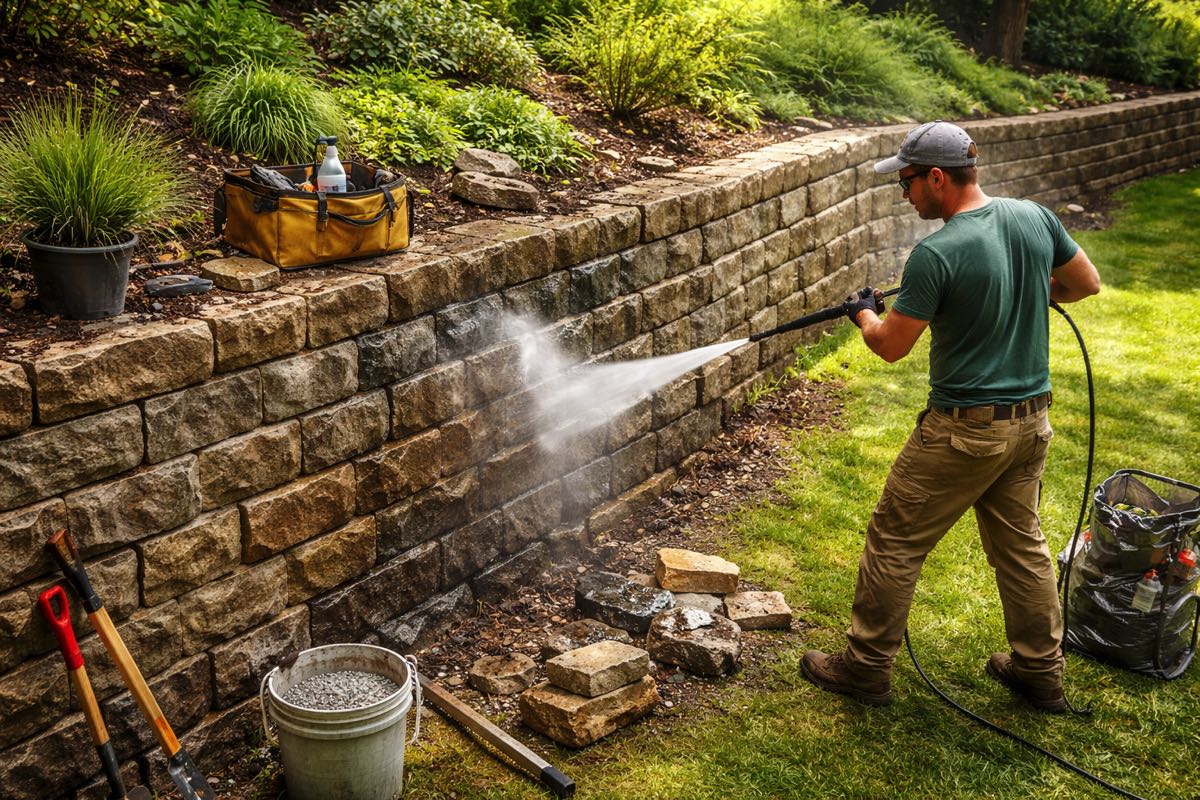
Removal is cosmetic. A stiff brush and water works. Low pressure washing is fine on concrete block. Keep pressure washers off mortared stone joints and off timber entirely. Growth returns within a season or two.
Plants Near Retaining Walls
Roots are the second most common cause of drainage failure, after silting.
Plant these well back. Willow, poplar, bamboo, English laurel, and Douglas fir have aggressive root systems that find and colonize drain rock. Douglas fir roots travel much further than most homeowners expect on wooded lots.
These are safe near the wall. Kinnikinnick, sedum, creeping thyme, ornamental grasses, and sword fern. Sword fern thrives on the shaded north face of most Gig Harbor walls and needs no care.
The Rule: anything that will grow taller than the wall should be planted at least as far back as the wall is tall.
Timber Walls Fail Differently
Pressure treated timber walls in western Washington last 15 to 25 years. Not 40. Not 50.
The failure point is the buried back face. Wood sits in permanently wet soil and rots from behind, invisibly. The wall looks sound until a section gives.
Sealing the exposed face does not prevent this. Sealant never reaches the buried side, and sealing can trap moisture inside the timber. Treat any recommendation to seal an aging timber wall as a life extension measure with skepticism.
Signs a timber wall is near end of life:
- Wood that softens when you push a screwdriver into it
- Rusted or pulling tiebacks
- Individual timbers bowing outward
- Any section that moves when leaned on
Concrete segmental block and properly built natural stone deliver the long lifespans. Both can exceed 25 years in this climate with working drainage.
RELATED: Different Types of Retaining Walls
DIY or Contractor
Handle yourself: clearing weep holes, cutting back vegetation, rerouting a downspout, resetting a loose cap block, cleaning the face, regrading a small area.
Call a landscaper: anything involving lean, bulge, or blocks that have shifted relative to each other. These are pressure problems. Pressure problems get solved behind the wall. Patching the front of a bulging wall is cosmetic work on a structural failure.
Walls over four feet in Pierce County generally require a permit and engineered drawings. Confirm current requirements with Pierce County Planning and Public Works, and check City of Gig Harbor rules separately if you are inside city limits.
When Maintenance Cannot Save a Wall
Some walls were built wrong. Maintenance will not fix them.
Common installation defects:
- No drain rock behind the wall
- No perforated drain pipe at the base
- No geogrid reinforcement on a wall tall enough to require it
- Wall built on soil instead of compacted gravel base
These surface five to fifteen years later as unexplained lean. If your wall has been repaired twice for the same issue, the problem is behind it.
Protect the Wall You Already Paid For
Most walls get built, look excellent and get ignored for a decade. Then a wet winter produces a real bill.
Two inspections a year and clear weep holes prevent most of that.
If you see lean, bulging, cracks over 1/4 inch, or water where it should not be, contact Garland Landscape. Chris has been building and repairing walls in this area for over 19 years. We will tell you whether it is a drainage repair or a retaining wall rebuild. Those are very different numbers.
Garland Landscape serves Gig Harbor, Port Orchard, Tacoma, Fircrest, University Place, and Lakewood.
RELATED: Retaining Wall Installation | Yard Drainage Solutions
FAQs
Do retaining walls need maintenance?
Yes. Clear the weep holes each September and inspect twice a year. In western Washington, drainage maintenance matters far more than surface care.
How long does a retaining wall last in western Washington?
Concrete segmental block and well built natural stone exceed 25 years with working drainage. Pressure treated timber lasts 15 to 25 years because the buried face stays in wet soil. Drainage quality affects lifespan more than material choice.
How much lean is too much?
More than 1/4 inch of tilt per foot of wall height is structural. Any visible lean warrants inspection. Walls do not correct themselves.
What crack width should worry me?
Under 1/8 inch and stable: monitor. Between 1/8 and 1/4 inch: address this season. Over 1/4 inch, or any diagonal stair-stepping crack across multiple blocks: call a landscaper.
Should I seal my retaining wall?
Sealing concrete block is cosmetic and reduces efflorescence. Do not seal a timber wall expecting longer life. Timber fails from the buried side, and sealant traps moisture.
Why is my retaining wall green?
Moss and algae are normal in this climate and structurally harmless. Keep weep holes clear, since heavy growth blocks them.
When should I inspect my retaining wall?
September and April. September prepares drainage for the wet season. April reveals winter damage. Photograph the same spots each time.

As the owner of Garland Landscape, Chris brings over 19 years of experience in landscaping and hardscaping to every project.